Party leaders surprised by attendance at candidate meet-and-greet
170 people packed Roscoe Township Community Center to hear economic anxiety and public service take center stage at a Democratic candidate meet-and-greet.

Publication of this story was delayed to allow Republican leaders to comment on this story. Still to come: a report on another Roscoe meet and greet, with quotes from the candidates who want to represent Roscoe in Winnebago County Board District 7.
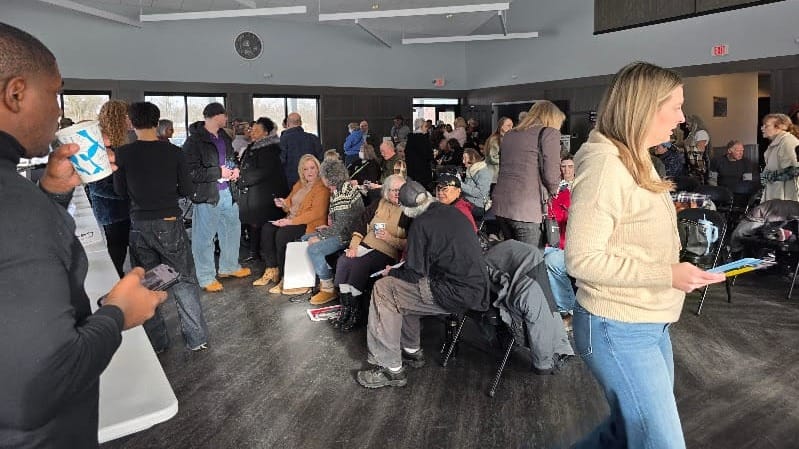
When the Winnebago County Democratic Party completed the application to use the Roscoe Township Community Center for a local Democratic candidate meet-and-greet, they told the township they did not expect more than 50 people to attend. Just before 9:30 on Saturday morning of January 31, 2026, all the chairs at the community center were filled.
Total attendance was estimated at 170 people, many of them from outside Roscoe. The parking lot and the side lot were full, leaving some attendees to walk on the side of the road. The remaining crowd filled in empty spaces at the back to hear a slate of local, state, and federal candidates pitch their case as to why they are the best pick for the March 17 primary.
Republicans were more skeptical. Party leader John M. Guevara told us, “Democrats make plenty of promises to fix the mess they created. Illinois Democrats passed a billion in new taxes last year. They’re taking half a billion more from our roads to fix Chicago problems. But never fear. Just vote for them one more time, and then they’ll make you a priority.”
Photos from the event

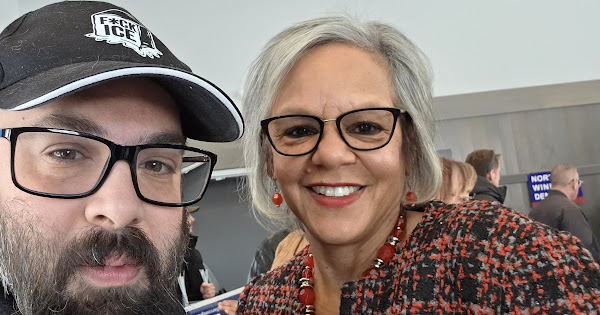
Regardless, at the Democratic event, economic survival and the moral obligation of public service were the dominant themes as hopefuls for the 2026 primary addressed a crowd eager for change. From congressional challengers to state watchdog hopefuls, the message was clear: Illinois families are struggling, and the "old way" of doing politics is no longer enough.
Even though only one-third of Rockton, Roscoe, and South Beloit voted Democrat in 2024, most statewide offices in Illinois are held by Democrats, increasing Republican interest in Democratic primaries. Democratic candidates are expected to make a stronger showing in 2026’s midterm elections.
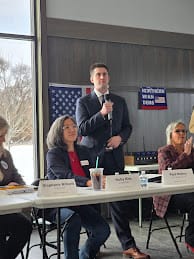
"Our Kids’ Futures Are on the Line"
Paul Nolley, a Democratic candidate for Illinois’ 16th Congressional District, opened the evening with a blunt assessment of the American economy. Despite technological and macroeconomic growth, Nolley argued that the benefits aren't reaching the kitchen table.
"Our kids’ futures are on the line," the Roscoe resident told the crowd, noting that more than half of Americans are currently living paycheck to paycheck. Nolley, who is seeking to unseat the incumbent Congressman Darin LaHood, in the upcoming March 17 primary, emphasized that economic data means little if the average worker is struggling to survive.
The Watchdog vs. The Accountant
The race for state-level oversight saw State Senator Karina Villa making a passionate case for her candidacy for Illinois Comptroller. Four Democrats appear in the primary ballot. Bryan Drew is the only Republican running for Comptroller.
Villa sought to differentiate the role from a standard bean-counter, framing the office as a critical check on government power.
"You are not hiring an accountant," Villa said. "You are hiring a watchdog."
Villa outlined a three-pillar platform focused on rigorous reconciliation, supporting the state’s most vulnerable populations, and radical transparency. With the state handling roughly 16 million transactions a year—averaging one every 15 minutes—Villa argued that financial oversight is a moral imperative. "Every single dollar is a reflection of what we spend and what we care about," she added.
Labor and the "Real Money Job"
The conversation shifted toward local infrastructure and labor as candidates discussed the looming influx of data centers in the region. Holly Kim, also vying for the Illinois State Comptroller seat, emphasized the need to "cut waste" while ensuring that "prevailing wages are championed before and while all the data centers pop up."
The goal, according to speakers, is to ensure the region attracts "real money jobs for real money people," ensuring that new industry translates into livable wages for local residents.
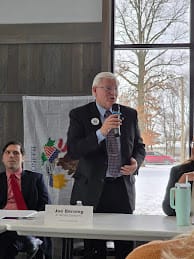
Service Beyond Retirement
From the northwestern corner of the state, Joe Berning of Galena, a candidate for the 45th State Senate District, shared his personal motivation for entering the fray. He hopes to unseat Republican Andrew Chesney of Freeport.
"I couldn’t stand being retired with so much left to do," Berning said, echoing a sentiment of restless civic duty. "We are here on this earth to serve one another. There are too many politicians who do not understand that." Berning emphasized that his campaign is rooted in the "responsibility of the office" rather than the perks of the position.
When the panel was asked what the biggest problem facing the state of Illinois is, Berning's response contained a solution. "The biggest problem Illinois is facing is people not working together to get problems solved," Berning said. When asked how to win over Republican voters in red-leaning areas, his answer was simple: "Work genuinely and kindly across the aisle."
Organizing Without Permission
The event also featured veteran organizers and local leaders who stressed the power of grassroots movements. Kevin Lamm, a candidate for State Central Committeeman and a longtime local party leader, reminded the audience of the autonomy of the voter. "You do not need permission to organize," Lamm stated, urging attendees to take the lead in their own communities.
Patrick Cortesi, chair of the McLean County Democrats, reflected on past successes, such as the 2017 effort that forced the only in-person town hall with Darin LaHood.
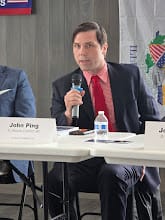
The Illinois Primary Election is scheduled for March 17, 2026.