Village of Roscoe and City of South Beloit could have $90 million of infrastructure projects in the near future
$41 million for Willowbrook projects alone, Willowbrook and Prairie Hill Rd will (finally) get a stop light, Roscoe's Main Street will be overhauled from McDonald to Elevator Road.


South Beloit and Roscoe are in the design and engineering stages of more than $90 million of infrastructure projects, according to the 2025 Council of Governors for Region 1 Infrastructure Priorities report. If funding is secured, Willowbrook Road alone will feature five total projects, totaling almost $41 million.
The centerpiece of this regional revitalization is the joint effort to transform Willowbrook Road. Recognized as a vital corridor for economic expansion, both municipalities are working in tandem with the Illinois Department of Transportation (IDOT) and the Illinois Tollway Authority to upgrade the road to a concrete Class II truck route.
- South Beloit’s Role: Reconstructing the segment from the State Line to Prairie Hill Road ($12.87M), including new traffic signals to facilitate heavy vehicle flow.
- Roscoe’s Role: Extending the reconstruction from Rockton Road to McCurry Road ($16.87M), mirroring the truck-route upgrades to ensure a seamless transition for freight.
By replacing aging infrastructure and increasing traffic capacity, the two municipalities are effectively "unlocking" hundreds of acres of commercial land near I-90, signaling to developers that the region is ready for high-impact industrial and retail growth.
South Beloit: expanding municipal sewage service
Beyond the joint roadwork, South Beloit is prioritizing its underground utilities to prevent system failures and support new residential connections.
Major Sewer & Utility Upgrades
- Force Main & Lift Station Project ($5.03M): Replacing the 1956-era Lift Station No. 1. This project is a critical fix for a system that suffered a major failure in 2019, ensuring reliable sewage transport across the Rock River.
- Prairie Hill Sewer Extension ($9.55M): A massive undertaking to connect 123 properties—spanning 450 acres—currently on septic systems to the city's wastewater treatment plant. The project will extend from the existing lift station at Prairie Hill Road and De La Tour Drive, running east along Prairie Hill Road and south along Dearborn Avenue
- Willowbrook Road Sewer ($1.13M): 2,250 feet of new main to service 70 acres of prime undeveloped commercial land from the city's southern end to Prairie Hill Road. This also connect the city's sewage service to the 30 acre campus recently purchased by Woodman's.
- Prairie Hill Elementary Extension ($492K): A targeted project providing city sewer to Leo Lane residents and Prairie Hill Elementary which currently operates on a septic system. Sewage service will also be extended to the residential neighborhood north of Amazing Grace Lutheran Church located at the SW corner of Prairie Hill Rd & Willowbrook Rd.
Roscoe: Enhancing Connectivity and Downtown Appeal
The Village of Roscoe is focusing its efforts on a "multi-modal" future, blending heavy-duty industrial roads with pedestrian-friendly downtown spaces.
Downtown & Pedestrian Projects
- Main Street Reconstruction ($20M): The largest single project in the lineup. It will stretch from Elevator to McDonald Rd. (ending at the Roscoe YMCA entrance) and transform the downtown business district with "urban roadway" features—curbs, gutters, and enhanced streetscapes. A dedicated pedestrian bridge will be built alongside the Kinnikinnick Creek bridge to improve safety.
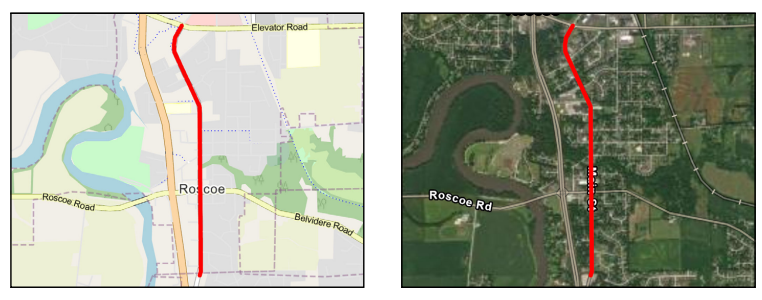
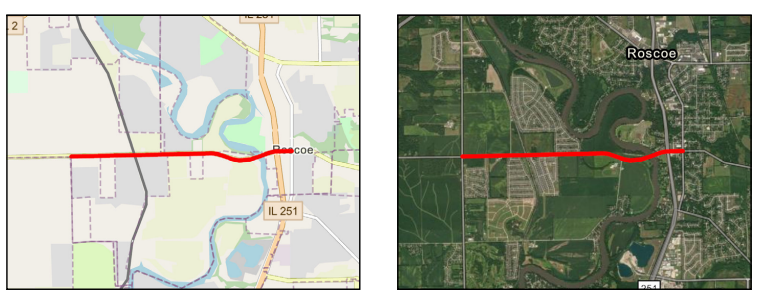
- Roscoe Road Multi-Use Path ($8.82M): This project will finally bridge the gap for pedestrians and cyclists, stretching from downtown Roscoe near Bridge Street, crossing west over the Rock River, and ending at Old River Road to connect west-side neighborhoods directly to the downtown core.
Industrial Logistics
- Love Road Reconstruction ($14.86M): Complementing the Willowbrook project, Love Road will be upgraded to a Class II truck route between Rockton and McCurry Roads. This includes a safer intersection realignment and a new culvert designed specifically to support heavier freight loads.
Adding Color: Joe Kurlinkus's responses provide context to the "long-term safety, mobility, and economic vitality" these projects provide.
We reached out via email to Village of Roscoe administrator Josef Kurlinkus who added context to these projects featured in the Council of Governors Region 1 Infrastructure Priorities Report. The questions and responses follow.
1) How "ready to go" are these projects? Like, are these a done deal and waiting for shovels to break ground? Do they need some more study and approval?
Inclusion of projects in the R1 Priorities Report helps the Village clearly demonstrate its prioritization of key infrastructure and development needs and allows us to coordinate more effectively with regional partners such as the R1 Council of Governments and the Metropolitan Planning Organization (MPO). The report is primarily a planning and advocacy tool, helping communities align priorities regionally and position large-scale infrastructure projects for potential state and federal funding assistance.
The projects identified in the report are not all “shovel-ready,” nor are they intended to suggest that construction is imminent across the board. Several of the major roadway projects, however, are well advanced from a technical standpoint. The Love Road, Willowbrook Road, and Main Street reconstruction projects are approximately 90% complete from an engineering and design perspective. However, 90% engineered does not mean fully funded. These projects are largely through technical review and are now primarily awaiting final funding commitments, scheduling, and remaining approvals before construction timelines can be established. Other projects included in the report — such as elements of the multi-use path system — are at earlier stages and will require additional study, design refinement, and coordination.
2) How would these projects be funded? Bonds? Grants? To what extent are the local and state governments (even federal) helping fund them?
These projects would be funded through a combination of sources rather than a single mechanism. That typically includes federal and state transportation grants, regional programs, and local matching funds. Local contributions may come from a mix of municipal capital funds, impact fees, and, where appropriate, bonding. Inclusion in the COG priorities report helps make these projects more competitive for outside funding, particularly large federal and state grants, which often cover a significant portion of total project costs.
3) Roundabouts or stoplights at intersections? If no roundabouts...my mom would have thanked you...but we anticipate some readers will ask "why this over that?"
Intersection treatments are evaluated on a case-by-case basis. Traffic volumes, safety data, truck movements, available right-of-way, and proximity to adjacent properties all factor into whether a roundabout or a signalized intersection is recommended. In some locations, signals are more appropriate due to space constraints or heavy truck traffic; in others, roundabouts may offer safety and operational benefits. These decisions are made through engineering analysis and public input rather than a one-size-fits-all approach.
4) How would locals be able to be employed on these projects?
Most of these projects, particularly those using public funding, would be bid through standard public procurement processes. While contractors are selected competitively, these projects do create local employment opportunities through construction trades, materials suppliers, engineering services, and ongoing maintenance. Additionally, infrastructure improvements are often a catalyst for private development that generates longer-term local jobs beyond the construction phase itself.
5) Anything that you really want the public to know about the benefits of these projects?
The most important thing for residents to understand is that these projects are about long-term safety, mobility, and economic vitality. Improvements to roads like Willowbrook, Main Street, and Love Road enhance traffic safety, support existing businesses, improve access for emergency services, and make the community more attractive for future investment. The multi-use path projects also expand safe options for walking and biking, which supports quality of life and connectivity across the region.